







New reporting from Bitwise suggests that Bitcoin’s (BTC) undervaluation could expand if investors’ concerns over sovereign debt deepen. The asset management firm said that mounting pressure in global bond markets and rising government debt levels could strengthen Bitcoin’s role as a hedge against macroeconomic risks, with one valuation model suggesting a theoretical fair value of $224,000.
Debt market turmoil may support Bitcoin in the long-term
Bitwise pointed to mounting pressure across the global bond markets. The Organization for Economic Co-operation and Development (OECD) estimates governments and companies will need to borrow roughly $29 trillion in 2026, up 17% from 2024 and nearly double the amount raised a decade ago. Around 78% of OECD government borrowing is expected to be used solely to refinance existing debt.
10-year sovereign swap spreads across nations. Source: Bitwise
Bitwise noted that Japan remains a key focus. The country’s 10-year government bond yield recently climbed to 2.78%, while its 30-year bond yield reached a record high. At the same time, Japan’s public debt stands near 230% of GDP, among the highest levels in the current macroeconomic environment.
The report noted that Japanese investors hold approximately $1.2 trillion in US Treasurys, but higher domestic yields are making overseas bonds less attractive. Currently, the 10-year Japanese bond yield is 2.66% on Tuesday, compared to 2.19% for Yen-hedged 10-year US Treasurys, potentially encouraging capital to return to domestic markets.
Bond market stress is not limited to Japan. US 30-year Treasury yields recently reached 5.11% on May 11, its highest level since 2007, while sovereign risk premiums, measured through 10-year swap spreads, have risen to their highest levels since the European debt crisis of 2011-2012.
While these trends could weigh on risk assets in the short term, Bitwise believes a deeper bond-market disruption could eventually become a bullish catalyst for Bitcoin if central banks are forced to inject liquidity to stabilize financial markets.

Bitcoin probability of default vs model value. Source: Bitwise
The firm cited a model developed by investor Greg Foss that values Bitcoin at roughly $224,000 if it gains broader adoption as a hedge against sovereign default risk. Bitwise stressed that the figure is a theoretical estimate rather than a price target.
Despite the long-term bullish case, the report noted that Bitcoin may remain range-bound in the near term as higher real yields and tighter financial conditions continue to pressure demand.
Related: Bitcoin back in ‘distribution phase’ as extreme fear grips crypto market
Declining real yields may improve Bitcoin’s macro backdrop
Bitwise noted that Bitcoin’s near-term outlook may depend heavily on real interest rates, which measure the Federal Reserve’s policy rate after adjusting for inflation. In the report, real rates are calculated as the Fed Funds rate minus US CPI inflation. Historically, Bitcoin has tended to perform well when real rates fall, as cash and bonds become less attractive in inflation-adjusted terms.
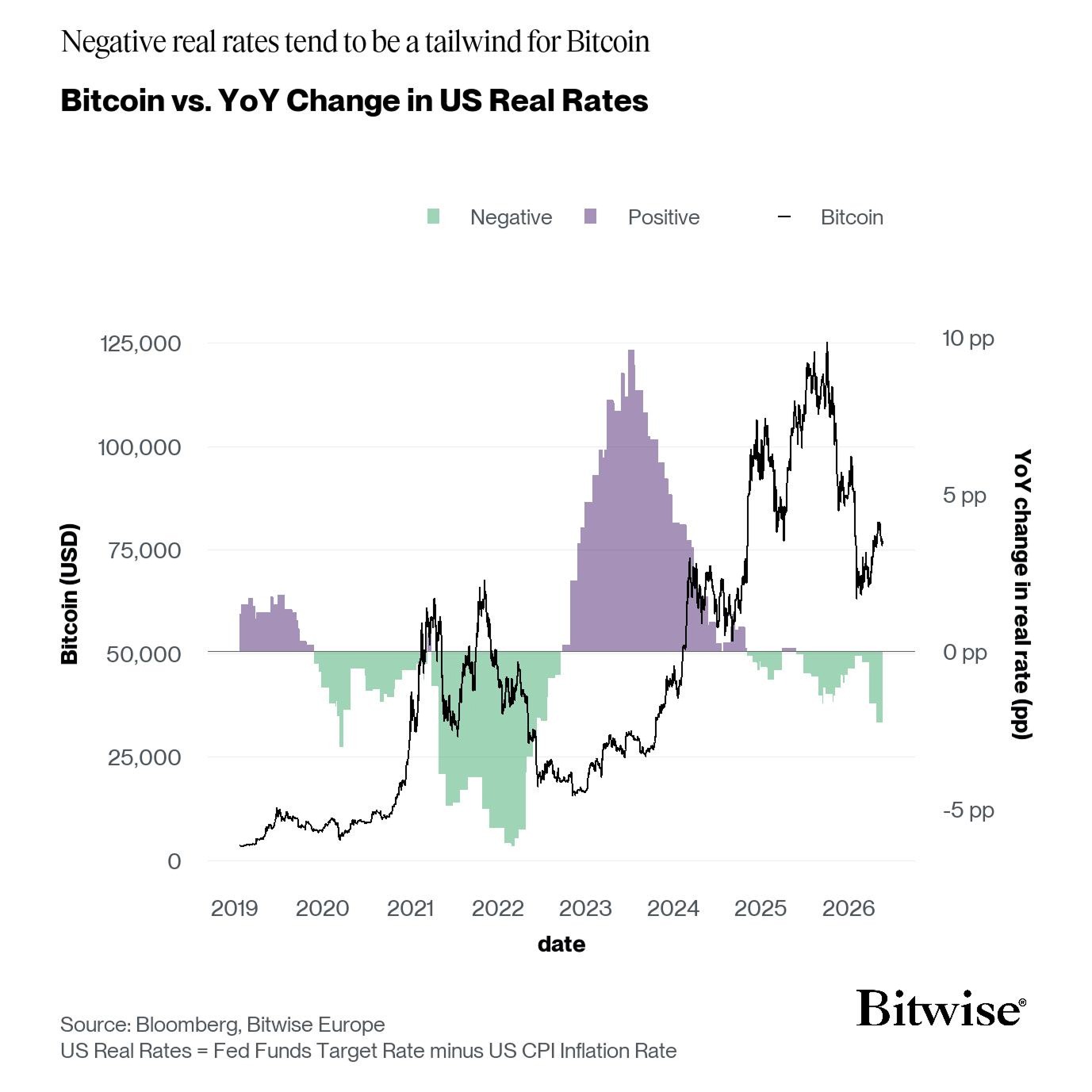
Bitcoin vs year-on-year change in US real rates. Source: Bitwise
The firm noted that Bitcoin’s 2021 bull market coincided with declining real rates, while the 2022 bear market unfolded alongside rising real rates and aggressive monetary tightening. Although real rates remain restrictive, Bitwise said that a scenario in which inflation rises while the Fed keeps rates unchanged could push real rates lower, potentially creating a more supportive backdrop for Bitcoin.
Meanwhile, Bitcoin researcher Sminston outlined that BTC could trade between $90,000 and $255,000 by the end of 2026, based on the Bitcoin Decay Channel, a logarithmic price model that has historically identified major cycle tops and bottoms. The analyst noted Bitcoin’s recent rebound emerged near the model’s long-term support zone, keeping the broader bullish outlook intact.
Related: Bitcoin volatility is down 56% but analysts still expect up to 20% BTC price move


