







Binance’s faltering European Union Markets in Crypto-Assets Regulation (MiCA) license application in Greece has raised questions about whether the bloc’s central bank may have played an informal role in the process, despite not having formal authority over licensing decisions.
Even though MiCA assigns approval of crypto-asset service provider (CASP) licenses to national competent authorities (NCAs), lawyers told Cointelegraph that its wording does not prevent other EU institutions, including the European Central Bank (ECB), from communicating with those regulators during the review process.
“Nothing in the MiCA framework would prevent a third party like the ECB from offering its opinion to that national authority on Binance’s application,” David Lesperance, founder at Lesperance & Associates, told Cointelegraph.
The Big Whale reported on Wednesday, citing unnamed sources, that ECB President Christine Lagarde had signaled to Greek Prime Minister Kyriakos Mitsotakis that Binance was not welcome in Europe. The report followed a Reuters story on Tuesday that Greece’s market regulator was set to reject Binance’s MiCA application.
The reports surfaced less than two weeks before the end of MiCA’s transitional period on July 1, a deadline that will determine which crypto firms can continue operating across the EU under its licensing regime.
Who actually decides under MiCA?
Under MiCA, CASP licenses are granted by national regulators, not by EU-level institutions like the ECB. In Binance’s case in Greece, that authority sits with the Hellenic Capital Market Commission (HCMC). The exchange said in January that it had applied for a MiCA license in Greece.
“Our understanding is that the HCMC completed its review of the application and considered it compliant with MiCA requirements. Our understanding is also that the application was subject to review at the European Securities and Markets Authority (ESMA) level,” Binance wrote in a blog post following the Reuters report.
A Binance spokesperson told Cointelegraph that the company believed ESMA intended to advance the application and authorize it at an upcoming board meeting. The company did not respond to an additional request for clarification. The ESMA does not itself authorize CASP licenses under MiCA.
Yuriy Brisov, a lawyer at Digital & Analogue Partners, said the HCMC hasn’t published a decision on Binance’s application.
Related: BitGo courts crypto firms awaiting MiCA approval amid Binance licensing concerns
Brisov said MiCA “contains nothing that stops the ECB from talking to, advising, or sharing concerns” with a national regulator. However, he noted that ECB involvement is explicitly defined only in certain parts of MiCA, particularly rules governing stablecoin issuers, not CASP licenses such as exchanges like Binance.
Source: EUR-Lex
“That’s a concern that MiCA parks in the stablecoin chapter, not in the exchange-license one,” Brisov added.
Stablecoins raise the political stakes
The ECB has consistently voiced concerns about privately issued stablecoins, favoring tokenized financial infrastructure anchored by central bank money instead. According to The Big Whale, Lagarde’s reported intervention was tied to stablecoins.
Lagarde has argued that Europe should prioritize regulated settlement systems rather than rely on private stablecoins, while ECB Executive Board member Isabel Schnabel has warned that stablecoins could even reinforce US dollar dominance.
At the same time, market data underscores Binance’s position as the world’s largest stablecoin exchange and the dominant hub for stablecoin liquidity.
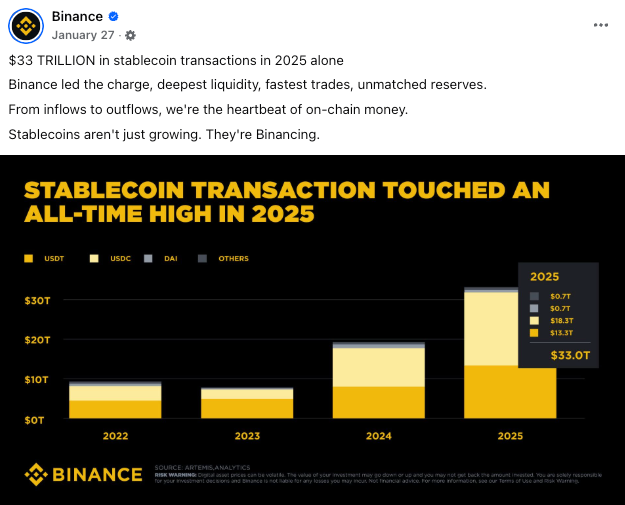
Source: Binance
According to CryptoQuant data reported in February, Binance held approximately $47.5 billion in USDT and USDC combined, representing about 65% of total stablecoin reserves across centralized exchanges. That figure was up from roughly $35.9 billion a year earlier.
Related: AllUnity debuts SEKAU, a fully reserved Swedish krona stablecoin
The Big Whale also reported that France could be Binance’s remaining route, though no formal French application had been filed.
ESMA and HCMC did not immediately respond to Cointelegraph’s requests for comment. The ECB and French regulator Autorité des marchés financiers (AMF) declined to comment.
Magazine: Crypto wanted to overthrow banks, now it’s becoming them in stablecoin fight


