







Australia’s proposed changes to capital gains tax could lead to smaller profits for cryptocurrency traders, especially low-income earners, and could discourage “patient investing,” according to several crypto executives.
The proposed reform, announced by the ruling Labor Party on Tuesday as part of its fiscal year 2027 budget, will bring in a minimum 30% tax on capital gains and scrap the 50% capital gains tax discount on assets held for more than 12 months.
Robin Singh, CEO and founder of crypto tax platform Koinly, told Cointelegraph the proposed changes are a mixed bag: The new system “theoretically” protects investors from being taxed on purely inflationary gains, but in practice, most crypto investors will pay more tax, with low-income earners hit the hardest.
“A lower-income earner who would have paid around $3,800 under the old rules, 19% on a $20,000 discounted gain, will pay $10,200 under the new ones. That’s nearly triple. For students, part-time workers and anyone without significant other income, this is the biggest shift,” Singh added.
Many investors, particularly Gen Z and Millennials, have seen crypto as a way to create wealth and long-term financial well-being. The new tax changes could impact that notion. A 2025 report from crypto exchange Independent Reserve found that 30% of people were investing in crypto to diversify their portfolio, while 25% were trading to get rich.
“For retail and mid-sized holders, the hodl tax incentive is effectively gone. Crypto has historically grown much faster than inflation, so the inflation adjustment doesn’t come close to offsetting the loss of the 50% discount. With no tax reward for sitting on positions, expect more frequent trading and shorter holding periods.”
A quarter of people are trading crypto to get rich. Source: Independent Reserve
“That said, the market has always adapted. Investors will rework their strategies, advisors will rework their advice, and the dust will settle,” Singh added.
Crypto trader behavior will likely shift
Jonathon Miller, the Australian general manager for crypto exchange Kraken, agreed that the changes will make long-term crypto holding less attractive.

Source: Crypto Tax Made Easy
“The bigger risk is that reducing the benefit of long-term holding makes patient investing less attractive, particularly in a market where assets can be traded around the clock. That could push some investors toward shorter-term behavior, which is not necessarily the best strategy for long-term wealth building,” Miller said.
“The sector will continue to mature, but policy settings can influence whether that maturity is built around long-term confidence or shorter-term activity.”
Andrea Yuen, the co-CEO of Australian crypto trading platform Swyftx, said the tax changes could prompt crypto traders to shift to other avenues for long-term wealth creation.
“The change is likely to act as a catalyst for patient capital over the next few years. We expect a significant trend toward crypto allocations within retirement portfolios and self-managed super funds. Investors are essentially being incentivized toward structured, long-term wealth creation,” Yuen added.
Related: Coinbase launches crypto service for Australian retirement funds
Australian crypto exchange BTC Markets reported in its Investor Study Report that SMSF registrations increased 69% year-on-year during the 2024–2025 financial year.
New CGT rules need to pass through Parliament
The Australian government has argued that the changes will curb investor appetite for property purchases because, without tax incentives, property is less attractive as an investment and that could free up supply.
The new measures will apply only to gains accrued after July 1, 2027, and new homes are exempt. Critics argue that it will instead push up housing prices, stifle investment, impact business and add pressure to the new housing supply, The Australian reported on Friday.
The tax reforms will still need to pass through the Australian Parliament. Angus Taylor, the leader of Australia’s other major political party, the Liberals, has reportedly vowed to oppose the measures and repeal them if they form government after the next federal election in 2028.
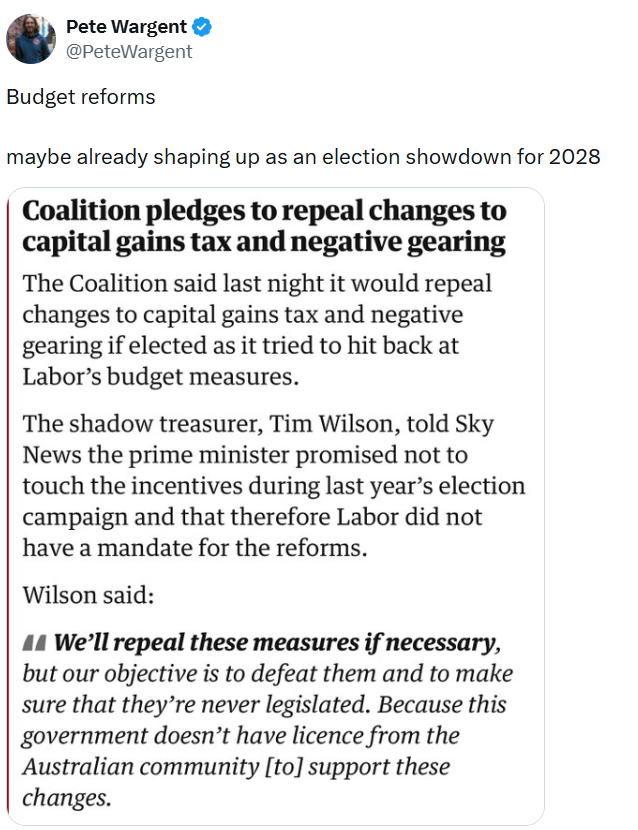
Source: Pete Wargent
The Labor Party will also need to get the tax reforms through the House of Representatives, with 76 votes required to pass, and through the Senate with 39 votes. Labor holds 94 seats in the House and 30 in the Senate.
Magazine: eToro founder timed Bitcoin top perfectly due to belief in 4 year cycles


