






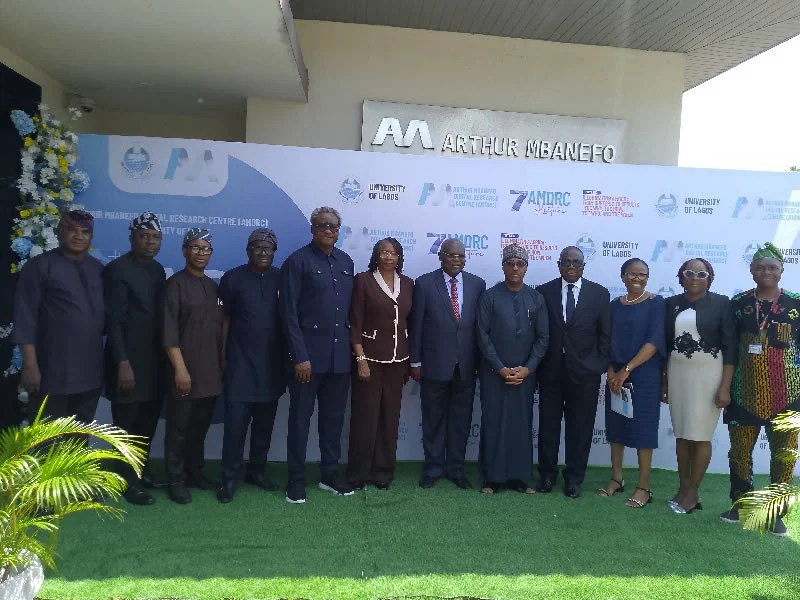
The Group Managing Director of Sahara Power Group, Kola Adesina, has challenged African universities, research centres and think tanks to move beyond theoretical scholarship and focus on producing solutions that address real-life challenges confronting the continent.
Adesina made the call while delivering the 7th Arthur Mbanefo Lecture titled, “Illuminating Africa: From Rhetoric to Results – The Why, the How, the Who, and the When,” at the Arthur Mbanefo Digital Research Centre, University of Lagos.
He said institutions of higher learning must become drivers of innovation, evidence-based policymaking and sustainable development if Africa is to achieve meaningful progress.
“Our universities, our research centres, including our think tanks and professional associations, must produce knowledge that is not just academic, but applied,” Adesina said.
“They must be incubators of solutions, connectors of people and advocates for evidence-based policy. This Arthur Mbanefo Digital Research Centre exists in this tradition. Its work matters.
Its voice must be amplified.”
He stressed that Africa’s development would require collective responsibility from citizens, institutions and governments, rather than reliance on political leaders alone.
Referencing leadership expert Simon Sinek, Adesina said, “Leadership is not about being in charge. It is about taking care of those in your charge.”
“That responsibility does not belong only to presidents and chief executives. It belongs to every person in this room. If you are a son or daughter, a parent, a teacher, a business owner, a community elder, a student or a public servant, you are a leader.
“The moment you accept that responsibility, the moment you stop outsourcing the future of Africa to someone else, something shifts.”
According to him, governments across Africa must build institutions that function beyond political cycles and pursue policies with long-term benefits.
“At the government level, we need leadership and systems that act beyond the next election cycle. We need policymakers who will make difficult decisions today for outcomes that will only be visible in 10 or 20 years.
“We need public institutions that function, that pay salaries on time, that deliver services efficiently, that protect citizens and investors alike. And we need accountability mechanisms that ensure those standards are upheld.”
He also called on professionals and citizens to contribute meaningfully within their various spheres of influence.
“At the personal level, we need each of us to own our sphere. We need doctors who bring excellence to every patient. We need engineers who refuse to cut corners. We need young people who demand better and then become better,” he said.
Adesina identified trust, collaboration, human capital development, infrastructure, policy consistency and innovation as critical ingredients for Africa’s development.
“It requires trust. Without trust between citizens and institutions, trust between investors and governments, trust between communities and leadership, nothing of lasting value can be built,” he said.
“It requires collaboration. No single entity, no government, no company, no institution and no individual can develop Africa alone.
“It requires infrastructure development. The physical backbone of development must be treated as a strategic national priority, not a political favour.”
On technology, he urged African countries to embrace innovation as creators rather than consumers.
“Africa cannot afford to solve 21st-century problems with 20th-century tools. We must embrace technology not just as consumers, but as creators.
“We must invest in digital infrastructure, in research and development, and in startup ecosystems that solve local problems at scale.”
Speaking at the event, Chairman of the lecture, fintech pioneer and banker, Dr Segun Aina, said universities would increasingly be judged by their ability to transform research into practical solutions.
“Future African universities will be measured not only by the quality of their research publications but also by their ability to convert knowledge into solutions, discoveries into enterprises and ideas into measurable improvements in the lives of people,” Aina said.
He described the Arthur Mbanefo Digital Research Centre as a critical platform for innovation and knowledge creation.
“At a time when the world is experiencing unprecedented technological disruption, geopolitical shifts, climate challenges and economic transformation, societies are increasingly defined by their capacity to generate knowledge, foster innovation and translate ideas into tangible progress,” he said.
“The centre embodies the recognition that research, innovation and knowledge creation are no longer optional components of development. They are indispensable foundations for national competitiveness and sustainable prosperity.”
Aina also called for greater urgency in Africa’s development agenda, arguing that the continent could not afford to postpone progress to future generations.
“The defining question before us today is whether Africa is prepared to develop. The answer, I believe, is now. Africa’s potential cannot be deferred to another generation,” he said.
“I always challenge the African Union every time I see the slogan that Africa will win in 2063. By 2063, I will not be around. I want to see the Africa that will win today and not in 2063.”
Earlier, the Vice-Chancellor of the University of Lagos, Prof. Folasade Ogunsola, said the lecture was significant as it also served as the first memorial lecture in honour of the late benefactor of the centre, Chief Arthur Mbanefo.
“Today, we celebrate the life, vision and enduring legacy of an extraordinary statesman and philanthropist whose commitment to knowledge and national development inspired the establishment of this centre,” she said.
“Through his generosity, the Arthur Mbanefo Digital Research Centre has become a vibrant hub for scholarship, innovation and digital learning within our university.”
Ogunsola expressed confidence that Adesina’s lecture would stimulate practical conversations on development and digital transformation.
“I am confident that his presentation will move us beyond declarations to engage practical pathways that can drive sustainable development and deepen digital transformation.
“I have no doubt that we will be challenged to bridge the gap between vision and execution,” she added.
Personalities present at the lecture included Sen Bode Olajumoke, Bayo Ojo (SAN), Pa Sam Amuka, Dr Bode Karunwi, Ernest Ebi, who is Chairman of the Arthur Mbanefo Digital Research Centre.
Read the full article here


